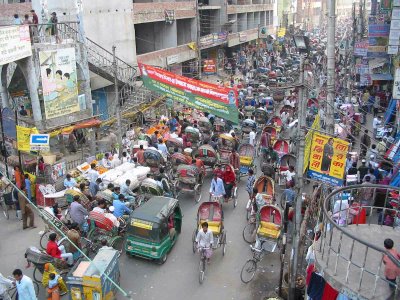
 DhakaIt is a stark reality that our region has been mired in terrorism, drug trafficking, human trafficking and environmental catastrophes as well as unbridled spread of pestilent diseases like HIV/AIDS and tuberculosis. As these problems are transcendental in nature, we have the daunting challenge to address them mutually by enhancing coordination among us.Poverty remains the most daunting challenge to our collective wisdom. Our past efforts have certainly helped reduce its intensity. Yet, we have to traverse a long way before this social evil is completely eliminated.Success is a matter not so much of talent or opportunity as of concentration and perseverance, where commitments are matched by actions.Programmes and activities of regional cooperation must contain poverty reduction elements. As trade has direct consequences for poverty reduction efforts, we must take adequate measures to ensure that poverty reduction becomes the outcome of a free trade regime.
If he is so concerned about poverty, he should have at least some sympathy for Maoists who are willing to die for their dream of classlessness. He should be able to see at least some common ground. Instead he blatantly dismisses them as "terrorists." I have always been critical of their violence, but I have also made room for them to change for the better. The king has not. His priority has been power for himself, not poverty reduction.
SAFTA should serve as a forerunner of a more ambitious and deeper economic integration to eventually realize the goal of a South Asian Economic Union. We believe that the signing of the four agreements on Promotion and Protection of Investments, Mutual Administrative Assistance in Customs Matters, SAARC International Commercial Arbitration Centre and Avoidance of Double Taxation will further strengthen the SAFTA regime with a positive bearing on the growth of intra-regional trade and investment.It has become imperative that we introduce and carry out parallel processes of economic integration and infrastructure development. Infrastructure development will obviously require huge investments.Our offer that Nepal serve as a transit point between India and China, the two largest emerging markets in the world, has been born out of our deep conviction that, in an era characterized by heightened competition to capture world markets and capital, increased trade and economic interaction between the two up-and-coming economic zones, facilitated by transportation and communication links, would provide a level playing field for both our neighbours to reap benefits of a promising global economic order.We are convinced that with our collective efforts and coordinated positions, the process of globalization can be turned into a force of growth and development in South Asia. Globalization in itself is not right or wrong; the impacts it creates on our way of life should be carefully analyzed. We do not want globalization to upset our harmonious social balance and crumble our rich traditions and cultures.An inclusive global information society must be our goal and we must firmly and collectively reject digital domination that seeks to make the rich richer and the poor poorer.
I like these segments of his speech where he talks of matters economic.
Terrorism has emerged as a serious threat to international peace, security, stability and democracy. The growing menace of terrorism, both at home and abroad, concerns us all. Terrorism has metamorphosed our world. My country has been the victim of senseless terrorism for nearly a decade now. The agents of terror are bent on overthrowing a constitutional order and replacing it with a rejected ideology of a one-party communist dictatorship.This is misleading of him to say this. For one, monarchy as a political ideology is even more archaic than Maoism. On the other hand he knowingly refuses to acknowledge the ideological leap of the Maoists to move from the goal of a communist republic to a democratic republic. These Maoists in Nepal are willing to shift to a multi-party framework. It is the king who is not accepting of that framework.
We would like to emphasize that, as terrorism knows no geographical boundary, terrorism in Nepal is certain to affect the whole of South Asia. Nepal condemns terrorism in all its forms and manifestations, committed by whomever, whatsoever and for whatever reasons. We expect a similar attitude on the part of the international community. South Asia must send a clear message that violence cannot be an instrument to further political objectives.The February First step in Nepal was necessitated by ground realities, mainly the failure of successive governments to contain ever-emboldening terrorists and maintain law and order. It has not come at the cost of democracy, as some tend to project it. We remind the international community of the pre-February First situation in Nepal. Our friends and well-wishers were warning us of the danger of Nepal turning into a failed state.Some guy by the name of George W. invented the term War On Terror. But the king is teaching Marxism to none other than Karl Marx himself, although knowing what I do know about George W. I would not equate W. with Marx or any thinker in any ideological camp. My point being your experiment has been one in dictatorship, not one in any War On Terror.
The terrorism card will not work. You have been watching too much television. The corruption card will work, but it will work against the palace and the army.
There is no place today in the Kingdom where security personnel cannot go at will.Is that why Nepal is number one in terms of human rights abuses in the world?
We believe that there cannot be a meaningful exercise in democracy without elections. We have also asked those who have been misguided to renounce violence and to take part in a competitive democratic political process.That is why we are for elections to a constituent assembly. Musharrafism has no place in Nepal. For that matter, it has no place in Pakistan either.
It is ironical to note that the global war on terrorism is not matched by global action against it. The global war on terrorism has failed to reach every nook and corner of the world, especially in weak and vulnerable countries, as if they do not deserve justice and protection from terrorism. It is this double standard and selective approach that is assuming a dangerous character rather than terrorism itself. We cannot make a distinction between good and bad terrorism; terrorism is terrorism. In our region, the Declaration of the 11th SAARC Summit held in Kathmandu categorically stated that “terrorism, in all its forms and manifestations, is a challenge to all states and to all of humanity, and cannot be justified on ideological, political, religious or any other ground”. We agreed that “terrorism violates the fundamental values of the United Nations and the SAARC Charter and constitutes one of the most serious threats to international peace and security in the Twenty-first century”. Nepal has ratified the SAARC Convention on Suppression of Terrorism and its Additional Protocol with the belief that these instruments provide an effective tool to counter terrorism in the region. We call upon the SAARC member states to forge a strong partnership to eliminate terrorism from the region as well as spearhead a coordinated and earnest action against it.I consider myself a minor authority on racism. I really like your bringing this up. If the US and Europe speaking for democracy is racism, where does that put India? Are Indians also racists? Where does that put the Nepali diaspora? Is that crowd also racist? I admire your guts to take on the big powers, but your claims are highly misplaced. The struggle for democracy in Nepal is not about those foreign powers. It is about the 27 million people in Nepal.
In order to promote people-to-people contacts on a larger scale, we must think of a visa-free regime in South Asia along with a free trade regime.Free and frank exchange of views among the leaders in an environment characterized by a greater degree of informality will help further promote trust and understanding.I wish he had the same attitude about the leaders of the seven party coalition. He does not even recognize their existence.
This Dhaka speech is a little more revealing than the Tunis speech for its political content. And there are parts of the speech that are praiseworthy, greatly so, most of them to do with the regional economy. That might suggest King Gyanendra is a smart individual. But that might as well be a strong case for a republican setup rather than a monarchical one. In a republican electoral fray, smart individuals like him and Baburam Bhattarai get to compete, and let the people decide as to who is more capable to lead.
My
Proposed Constitution can also be read as a proposal to reinvent the monarchy itself. On the other hand, if the king continue his intransigence, the document has a clear republican framework. We are not willing to wait forever.
TunisNepal is committed to the Geneva Declarations of Principles. We believe that the Internet, which has become omnipresent in our lives, can be truly beneficial to humankind if a multi-stakeholder participation, which is inclusive and transparent, can be developed. The international community needs to give special attention to the needs of the developing, land-locked and mountainous countries which face problems of promoting the use of ICTs due to high infrastructure costs.
The State's efforts have been further augmented with the establishment of an autonomous High Level Commission for Information Technology to enhance internal and external private investment and to stimulate new economic sectors like e-commerce. It is a matter of satisfaction that this has resulted in an ever-growing mutually beneficial partnership between the government and the private sector in the field of information technology.
The king did not say anything significant in Tunis. He merely offered a bunch of platitudes. There is no overarching policy intiative or technological breakthrough to be discerned here. It is not informative either to the political developments in Nepal, it not being a political speech.
He talks of infrastructure. He needs to understand 12 years of half-baked democracy did more for infrastructure in Nepal than more than 230 years of monarchy. That is not a statement on particular actors within that democracy, but on the ideal of democracy itself. That applies also to information technology.
When the king took over on 2/1, his first instinct was to cut off access to the internet from the country. That person is not a friend of information technology.
The internet is about opening boudaries and minds and societies. It is about interactive exposure. The king shut it off.
On the other hand, I could not imagine this democratic revolution without the internet. It is because of the internet that you can do almost everything except show up in the streets in Kathamandu when you are far away in New York City.
The king with his outdated politics is not helping the spread of the internet in Nepal. He is in the way.
It is only through the internet that a country like Nepal can hope to bridge the gap between itself and the richest countries. The internet is that fundamental.
When Nepal finally comes around to adopting my
Proposed Constitution, it will have adopted the first constitution in the world that has the word internet in it. It will be the first information age constitution for any country.
PodcastDecember 13, 2005 (15 minutes) My participation at the Nepal Democracy Forum online has made me much more understanding of and patient with the leaders of the seven party coalition in Kathmandu. The group made an important leap from the idea of moral support only to the idea of moral as well as logistical support. Then five specific projects were identified. There are people working on each. But the speed is so slow. Taking two weeks to compose a one page letter is not revolutionary work. Ego, ethnic prejudice, jealousy and primitive group dynamics come into play and slow down efforts.


