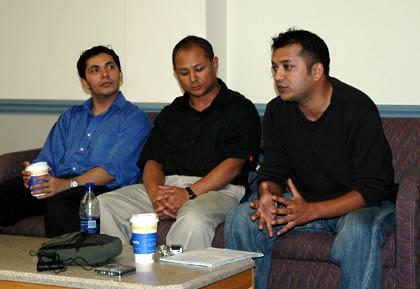
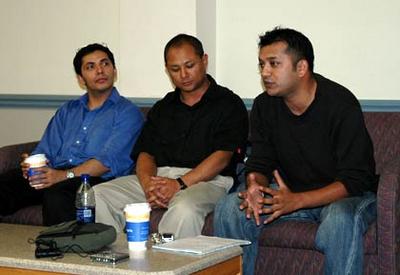
 Real Media, 12 MB Video file downloaded from sajha.com
I was really impressed to hear Gagan Thapa speak. He is articulate. He is analytical. He is the clearest voice to emerge from the new generation. It is only a matter of time before democracy is back in the saddle. I think. I think Gagan's importance will be more after democracy. To help lead the country's economic growth. The current struggle is a matter of months. The economic growth part will be years, decades. That second challenge is the real challenge.
I am like Gagan, I do not subscribe to the Knight In Shining Armor thinking. I don't think one hero will save the country. The commitment is to the democratic process. It is the democratic process that will save the country. It is that process that will grow the economy.
I think Gagan personally will play an important role, and I hope to be part of it, telecommuting (
21st Century Nepal), but the major way Gagan or anyone can contribute is through a firm commitment to the democratic process. That commitment is clearly there.
He keeps emphasizing what we do at this end helps back there in Nepal. I knew that. But it is good to hear it from him, so that we end up doing even more down the line.
What can I say, I look forward to seeing him in NYC. I think we are going to meet like old friends. I talked to some people he met in DC. They are all impressed.
"The most impressive, articulate leader after Madan Bhandari" was one comment. That is really saying something.
Gagan has been born a high caste male. But his thoughts on social justice are cuttinge edge. That is important. You can not dissociate peace from democracy and democracy from social justice.
His criticisms of the parties are welcome, as his criticism of the Nepali organizations in the US. I am glad he did that. My only formal membership in the city is with DFNYC. I participate in the Nepal events as a DFNYC member. I have to keep it manageable. I don't wish to spread myself too thin!
He is good in the streets. He is good at the podium. He is good one on one. He is good talking business with top American bureaucrats.
This guy is good!
Thanks Sage for the audio clip. We really need to capture him on video and put the video online at Google Video.
MP3 audio file, 14 MB (16kbps, 124:25)
I am here on a State Department program: I was invited twice before but this is the one time I finally accepted the invitation.
The Nepali diaspora in the US has been a huge help for the movement in Nepal. That help should be extended even more down the line. I met many officials in the State Department as well as other groups like the International Crisis Group.
It has become hard to present oneself as a Nepali. I am used to saying I am from the most repressed country in the world. The old identity has broken down. A new identity has not yet emerged. Our generation has to intervene.
This king is not a hereditary, obvious king. And he has character deficiencies.
Peace is the primary agenda item.
For the first time in history the monarchy is part of a vigorous debate. That debate has been raging in all villages, all towns, not just in Kathmandu. The myth that there will be no Nepal if there is no monarchy sustains the monarchy. Another source of power is the army. The king is at a crossroads. One, a slight compromise. Two, further crackdowns.
The Maoists. They have an army. 60-70% of the countryside has been controlled by them. Their weakness is the global failure of communism. They have an ideological clarity. The state is too weak. They are strongly committed. They also are at a crossroads. One, intensified violence. Two, accept multi-party framework and unite with the parties.
The third force, the parties. Ideologically, politically confused. Standing at a four-way. Their positive aspect: commitment to democracy. Lack of self-confidence among leaders, propensity to cut deals with the king. The parties have lost the trust of the people. The leaders are the main weak links.
I am not here to represent the Nepali Congress or my student organization. I am here to represent a generation.
Is this a problem or a crisis? This is a crisis. Small solutions will not help.
There is no need for a monarhcy in Nepal. This is not a statement made in rage. This is not an emotional statement. "Shree pench hamee jalaun chhaun, desh hamee chalaun chhaun." The monarchy is a feudal institution, nothing else. The hierarchical society we have, if we want to smash it, we need to get rid of the monarchy. There was a Shakya republic. Nepal has done without a monarchy in the past. We should move from superstition to science. I do recognize that Prithvi Narayan Shaha unified Nepal. History is full of incompetent, insane kings. But they still are great. What was the mistake of the people that the people had to put up with the Ranas for 104 years? We have been taught wrong history. 235 years of history weighs us down. What has only hurt us should not stay. The king and the ruling elite.
Why only men? Why only Brahmins? Why only Thakuri? The Dalit and the Janajati have risen through the Maoist insurgency. The Newars, the Tamangs. They are asserting their languages. There is voice that Chhath should be recognized. All these voices show the king does not unify Nepal. There were over 500 kings in India. China also had a king. Nepal does not need one either. Why keep a white elephant? Like Madan Bhandari used to ask. A dozen people a day are getting killed. But the prince rides the capital city streets in his expensive motorcycle. You know how much the monarchy costs. Why not keep a constitutional monarchy like in some European countries? But our monarchy does not have the character. We tried. There will have to be another democracy movement against King Paras, another against King Hridayendra.
People question Girija Koirala, Madhav Nepal. Will they lead the country? In 2046 B.S. there was a power shift from one elite to another. Like there was a shift in 2007 B.S. from the Rana to the Shaha.
What we have is a predator state. It is centralized. But the nation is diverse. We can not have democracy without decentralization. A primary school teacher in Jumla gets his appointment in Kathmandu. We did not change the state in 1990. Our problems are not new.
If I were born as a Gagan Bishwakarma, I would not be standing here today.
The Madhesh issue is huge. That problem started with Prithvi Narayan Shaha. Khasbadi, Purushbadi, Kathmandubadi, Rajabadi, Hindubadi.
Corruption continued after 1990. Noone can deny that. There are mistakes made in a democracy. But there also are laws to remedy, to punish the mistakes. The king is immune. He can do whatever. That pollutes the culture. 12 years of corruption, the solution is to strengthen the laws. The political parties are our representatives. There is hope the new generation can do better. A deviation to think is the parties failed, we need a master, we need a king. In summary, we don't see any use for the monarchy.
What is the difference between a Maoist republic and our republic? We don't want Prachanda to get the crown.
The people should be free to speak, but they also should be heard. The people are not just voters and taxpayers. The majority rules, but the minority is also heard. We have a vision for democracy.
How do we get there? Through a Constituent Assembly. I had no say in the 1990 constitution. But now the next constitution will be different. I will have a say in it. I represent a large section of the population, I think. But I can't be sure. That I have to prove during such elections. 75% of us under 35 have mostly seen democracy. We are not capable of accepting anything except democracy. And this is to be the final fight.
Some members of my team are from India. They talk of India as a future superpower. What do we have? I get jealous of them. You are in America, the oldest democracy. You have rights. We want the same rights. We have risked freedom and life. For what? This is a freedom struggle. How much can you help? When we heard of your DC rally, our morale was vastly boosted. Don't blame the parties and disown the democracy movement. Freedom is not free. This will be our final fight for democracy. In 10 years, you should be able to come back to Nepal. That is our vision. But we need your help now.
Question Answer Session
Comment: He is a great speaker. He is very analytical. I am impressed. It is hard for you and others to rise up the party ranks. The current leadership has failed. How does this hurt the prospects of democracy? Running a movement and running a country are different. Could you run the country?
Answer: I still don't have a lot of hope in the party leaders. But I have great hopes in our generation. There is a disconnect between the leaders and the cadres. The civil society movement has grown strong. The party leaders have few options left to compromise. I got kicked out of my General Secretary position of the NSU a year and a half back for speaking against the king. To run a country, you need brains, an environment, a commitment. We are working to create that environment, and we do have the commitment. We are a conscious generation. We have plans. We did not run the country well after 1990, true. But now we feel the need to do the homework. We will not repeat the mistakes of the previous generation.
Comment: If the crown is burnt. Girija said he will turn Nepal into a Singapore, instead turned it into a Jhingapur. What's the difference between Girija and you? What about Deuba? Deuba also was a student leader. Why should we trust you?
Answer: All heroes turned into villains. So I understand. I thank you for the question. But I only have the option to express my commitment that I will do my best. A lot of my friends do not think of politics as a career. This is a sacrifice. We have been at the forefront of the street demonstrations. There is one elected Dalit in the Congress central committee.
Comment: Your party is full of Bahuns and Chhetris.
Answer: In 1990 the elite got larger, that's all.
Comment: If you were to become Prime Minister, what would be your first act?
Answer: This thinking that one charismatic leader will come along and all problems will be solved, that can cause an accident. My focus is more on pointing out there is need for a decisive fight against the monarchy. We once told Girija Koirala, our generation will not have a Tulsi Giri or a Radha Krishna Mainali or a Parshu Narayan Chaudhari or a Prakash Koirala.
Comment: If you were to become Prime Minister, what would be your first act?
Answer: We first have to change this political structure. The power should be shifted away from the Singha Durbar to the lowest levels. To the village level. As for the hypothetical question what if the king wants to make you Prime Minister. Nobody from my generation will be interested. Then people asked, what if you become President. (Laughs)
Comment: China had Mao. India had Gandhi. Do you see you picking up the weapon? How committed are you?
Answer: Non-violence is our only weapon. That is the strongest weapon. Because the people are our power. What the Maoists could not do through eight years of violence, we did through eight months of non-violent demonstrations just in Kathmandu.
Comment: We hear some party cadres are getting ready to pick up weapons. Some Congress and UML cadres.
Answer: That is not true. That is wrong. There might be a few isolated individuals.
Comment: Some people think if the king and the Maoists will not lay down arms ......
Answer: We need to expand our political space through non-violence. Non-violence is the source of our power.
Comment: Your party itself is not democratic. How could we accept Girija?
Answer: Internal reforms, restructuring. There is a school of thought that says we should not raise these questions, that hurts the movement. Another says, the movement can not even begin if we don't reform. I am with that. How do you reform the parties? How to make them inclusive? That should reflect in the party structure. Parties do not do transparent book-keeping. They have 2-3 women in the central committee. We have not included the Dalits in the party structure. More people show up for civil society programs than for party programs. Since 1990, the NSU had eight central committees, three elected, five nominated. We can change Girija Koirala and Madhav Nepal. But we have to participate. If we don't participate, we can not.
Comment: Trust ....
Answer: The people are our power. We have to stick to non-violence. We have to rebuild the trust.
Comment: The Maoists are also Nepalis.
Answer: The Maoists want a Constituent Assembly. That Assembly has no substitute. Our proposal to the Maoists is that you lay down your weapons, and we can go ahead together. That will take us to a constituent assembly. That will give them a safe landing. We can not ignore the Maoists. That is why we don't agree with the king's idea of elections.
Comment: How will you fight two enemies? When you yourselves are not united? You seem to assume the Maoists will come along. Another assumption, you think the monarchy will go away. The truth is both remain strong.
Answer: The silent majority is not with the king. The silent majority is not with the Maoists. They are not with anyone. They are confused. Hence the parties need to reform, need to move ahead without compromising. We should bring the Maoists into the fold and fight a decisive fight against the king.
Comment: How will the Assembly come about?
Answer: It might be a long process. There is a South African example. It took them six years. We need UN mediation. I am not for the current 205 seats: that will be like repeating the mistakes of 1990. I am for a roundtable conference.
Comment: The current wave ...... (long comment)
Comment: How do people participate? The ballot box.
Comment: A revolution is different from a functioning democracy.
Comment: People are scared of criticizing the Maoists. There is biased criticism. You speak against the king. Can you speak against the Maoists?
Comment: What are we doing?
(More comments)
Comments: The Maoists are willing to hand over their weapons to go for a constituent assembly.
Answer: If non-violent ways are blocked, the people might turn to violence. That is there. But let me assure you, I am firmly committed to non-violence. People ask, why do you throw stones? In DC, there are demonstrations around the White House. Let me tell you about an incident. Recently. The New Road had been declared out of bounds. There were hundreds of police officers. We were hit with fire hoses. A friend and I were hit physically with tear gas shells. After that, the demonstrators started throwing stones, burning tires. So you have to look at it both ways. I am not asking you to get involved at the forefront. Look at the American war of independence. Look at the involvement. Must have been huge. Nepalis also have responsibilities. Your criticisms are welcome. But you must also participate. Criticize the leaders, but participate. There are no other alternatives.
Comment: Let's end the discussion.
Comment: How is this being internationalized?
Answer: India has regional ambitions. We should not compare today's India with the India 40 years back. India works out of its self interests. To complain against that is foolishness. There is a new thinking in India. They are willing to help the republican cause. As for Maoists and India. Also look at the EU. They are strongly supporting democracy. In the US. They are strongly opposed to a Maoist-parties alliance. They are willing to further pressure the king to that effect. They wrongly think the Maoists could take over Kathmandu. The January speech was strongly for democracy. Nepal was the first country where democracy was taken away. That was a slap to Bush. It is a prestige issue here. The Amnesty International has been following my case. There has to be intense lobbying. That is your work. You do it. DC rally, NYC rally: these have huge, humongous impacts back there in Nepal. Do not underestimate. The Nepali groups here are just like the parties in Nepal, too much squabbling. I saw. You can be more effective.
Comment: How can people here participate in the movement back there?
Answer: There is this huge Maina Sunuwar case coming along. Mobilize. Over email. Petitions. I met journalists here who know who Krishna KC is. Nepali students need to do similar stuff.
In The News
- Murari Raj Sharma UWB .... Gyanendra’s eight-month-long absolute rule has become a total disaster...... miserably failed to resolve the Maoist problem; his cabinet is an example of what a clean government is not; and the plunder of the treasury under him derides financial discipline ...... Pro-democratic rallies in Kathmandu and elsewhere have increased by leaps and bounds, both in frequency and in the number of participants. Even the pro-king party has said that it would join political protests. ...... economy has crashed...... Despite many overtures from Kathmandu, New Delhi has not found a convenient time to receive the king in India. The royal trip to New York had to be cancelled because no western leader was willing to meet an unconstitutional chairman of the council of ministers ....... regime is fast fraying to its core ....... Pushed against the wall, the king seems to have been contemplating to change the tune without altering the stage...... could go to any length to justify his February 1, 2005 power-grab and do anything to perpetuate it ...... First, he might continue to stick to his present course. Second, he could, ideally, seek the path of national unity and negotiated settlement to the Maoist insurgency. Third, the monarch could decide to reconcile with the parties hoping to weaken the rebels militarily and impose a solution on them. Fourth, he could reach out to the Maoists and work with them to the detriment of the democratic system. Finally, he could create conditions under which the parties and rebels join forces to work against monarchy........ If the king decides to stick to his present course, he will have to take draconian measures to crackdown on political parties and silence civil society, on the one hand, and to stamp out the Maoist rebels, on the other. Such policy will further enrage pro-democratic forces and widen their protests against the government, which in turn will respond with unimaginable brutality. This course will cause a massive loss of life, alienate people, and threaten the very existence of monarchy. World reaction to such a course will be extremely negative........ On the other hand, through his intransigence, the king may force political parties to more closely align with the rebels and work jointly against monarchy. As a result, the palace will be isolated; the violence will pick up as the government clamps down on the parties and rebels; sooner or later, monarchy will be abolished.... the king is sending very mixed signals. He must have been either trying to outfox others or operating out of desperation failing to see through the miasma of total confusion in which he finds himself....... the monarch has been seriously weighing the first option—to crackdown on his opponents, consolidate royal power, give a new constitution and introduce a guided multiparty democracy...... he has taken baseless, cheap shots at his opponents alleging that they are getting foreign funding to make trouble, something he could use as a pretext for a crackdown. Tulsi Giri’s outburst against the existing constitution as an obstacle to realizing the king’s objectives and Ramesh Panday’s rooting for different models of democracy are other pieces of the same puzzle........ his intention to mainstream the rebels by courting or dividing them...... Reportedly, King Gyanendra has maintained close contacts with the rebels from the beginning. Currently, some of his ministers, former Panchayat leaders, former army officials, and advisors have been working as his interlocutors with the rebel leadership in Nepal and India........ the king has described his differences with the parties as a squabble between husband and wife; left the door for dialogue open if the parties make their position clear regarding terrorism, nationalism, governance, and financial discipline. More importantly, the monarch has allowed the Supreme Court to examine the possibility of restoring the parliament for his safe landing if that became necessary........ the palace should rectify its blunders before it is too late. Otherwise, key parties, which have already jettisoned their commitment to constitutional monarchy from their statutes, and people in general might soon give up completely on the possible reconciliation with the king and go for a republican agenda in full throttle....... his anachronistic instincts, wild impulse, and blind ambition for unfettered power ..... No one should forget the fact that the king had anointed his son as crown prince when everyone was celebrating the big festival.